Friday, May 3, 2013

Prospection 30 April 2013


The 'prospection' stage in a foresight process answers the question 'What Might Happen?'

We played with two foresight methods tonight to explore what might happen to the Hub in the future.
The first was a visioning exercise, where the group 'travelled back and forward in time'. We imagined the Donkey Wheel House where this group works from (pictured below) and the activities, people, smells, sounds and feelings here in the past and future.

A vision is a compelling, inspiring statement of a preferred future which we want to create.


The second method we used is probably the most popular and well-known foresight method - scenarios.

Following Neil's suggestion we used an inductive scenario technique, scenario weaving, based on futurist Willis Harman's 'Harman Fan'. Neil's 'Scenario Weaving' is however different from traditional scenario techniques as it is not about time or chronology – rather about deeper understanding or texture.

Five sub-plots which came out of the visioning exercise (and earlier work) were mapped on a scenario field, as shown in the image here.


The five sub-plots (and possibly more) as well as the cross-weaves (how the sub-plots interact with each other on different levels) will now be developed in a shared document in our Yammer group.

When the output from the scenario work is finished, we will post it here on the blog.

Friday, April 19, 2013

#hubfutures Interpretation session 16 April 2013


Copyright: Tony Smith (@ynotds)

“The intuitive mind is a sacred gift and the rational mind is a faithful servant.

We have created a society that honors the servant and has forgotten the gift."

Albert Einstein


In Tuesday's session we played a bit with our intuitive minds to get deeper down in the collective intelligence and creativity of the #hubfutures group. 

After a brief introduction by Adam on the interpretation phase of the generic foresight process, we continued our dialogue around surprises from the past week. 


The fragments, sentences and key thoughts that were mapped on the 'iceberg' in last week's session were then used to prompt further insights and surprises. 

Jan Jelinek's "Music for Fragments" served as background music during eight minutes of reflection and individual work.

We all then spoke about what came up for us during this , and used images to explain new insights, surprises and possible stories for the future of Hub.


Some of the metaphors for Hub that emerged are illustrated in this image:


Until next session we will continue to explore and find questions. Questions which will be answered by scenario logics...

Friday, April 12, 2013

#hubfutures ANALYSIS session 9 April 2013


The purpose of our Hub Futures analysis session was to make sense of all the scanning we had done in the past month. Some of the scan hits are found in a shared Google Spreadsheet which is continuously updated with new observations and insights.

The analysis phase in a foresight process attempts to answer the question "What seems to happen?" and our objective of this session was to come up with a list of fragments which will later form stories, or scenario logics. The image here by Neil shows the process and how our thoughts from the scanning phase will lead to patterns, clusters, convergences and hopefully later; questions which will be the base for our scenarios. 


After a dialogue process with rapid two-minute pitches of scanning work to Brad, followed by general discussion we came up with lots of fragments. These were put on a whiteboard and clustered in a Causal Layered Analysis.

This futures method, by Sohail Inayatullah, allows us to take a layered view of the scanning fragments, and to get a deeper understanding of what lies beneath them. As the "iceberg" figure below illustrates, there are four levels of deepening. The litany level deals with the unquestioned, official view of something. The second layer looks at the underlying systemic drivers and trends, such as socio-economic, technical, political and environmental factors. The next layer concerns values and worldviews, and finally, at the deepest level, causal layered analysis looks at deeper myths and metaphors.

The analysis as shown here is what came to mind in Tuesday's session. The scan hits can be placed differently as they will mean different things to different analysts. Some hits were not placed on the iceberg as they came up in discussions after the dialogue, or didn't fit into any of the layers at the time.

Use the keyboard short cuts CTRL+ and CTRL- to zoom in and out as the font is quite small in this image....


Some ideas, clusters started to emerge:


 Until next time (16/4); look for surprises... they might be convergences, contradictions or other...

Thursday, March 21, 2013

Towards a Peer-to-Peer Technium


Last night Tony Smith gave a talk on how the convergence of Michel Bauwen's peer-to-peer theories and Kevin Kelly's Technium might impact our future.

After the thought-provoking presentation (slideshare here), we had a conversation about the consequences and implications for coworking spaces in general and Hub Melbourne in particular. Hub Australia CEO Brad Krauskopf shared his views on the future of Hub.

Some of the themes that were discussed around the table last night:

* What has Hub in common with jazz, movie making and the building industry?

* What is the main asset in a coworking space?

* How disintermediation, i.e. the removal of intermediaries, creates a new business paradigm.

* Coworking: From global connectedness and local impact to global connectedness and global impact through distributed networks?
 

http://www.rand.org/pubs/research_memoranda/RM3420/RM3420-chapter1.html
* Talent  and asset mapping

* How can coworking spaces be used for community building in rural and suburban areas?

* From coworking to co-learning?

* Does the Hub play a role in leader development of its members?

* The importance of hosting in social spaces

* The emergence of a coworking economy

The audio file with the recording of the discussion is found here.


Wednesday, March 13, 2013

Designing a Futures Wall


Today we started to design the #hubfutures wall. This space, based on a comment by Neil in a previous session, is a physical space where thoughts about the future of Hub will be posted.

Yesterday, we ran in to Ella from tincan who recommended us to check out artist Candy Chang's website for inspiration. Cindy's work combines installation art with social activism, and aims to encourage people to engage with public spaces to let their voices be heard.

That sounds a bit like what we want to do.

So far, the #hubfutures wall includes functions for:
 - Clustering scan hits according to a modified PESTEL framework with colour coded themes (culture/values, technology, business/economy, art, sociopolitics, environment and others).
- Reactions, insights, comments and feedback
- Action
- Peer-to-peer learning facilitation (through stickers where people can post according to an "Ask me more about this" template)
- Plot of scan hits on a time line

We'll continue the work on the wall next week.

Wednesday, February 27, 2013

#hubfutures explorers INPUT SESSION 26/2/13

This session started with Adam doing a brief presentation on the input part of strategic foresight work. Please see the SlideShare presentation here:


We then did a brief activity around the first "homework" - to bring three "things" which may impact the future of Hub. These were discussed in pairs with three questions by futurist Zia Sardar in mind:

  1. Does it make sense?
  2. Who benefits? 
  3. Where is this going?


All "things" were put on post-it notes, which were then mapped on a V STEEP framework on the whiteboard. Similar to a PESTEL analysis, this framework can be used to see how macro-environmental issues are related. Futurist Marcus Barber's V STEEP includes values, social, technological, economic, environmental and political factors.


The "scan hits" on the post-its were:


Tom and Neil reflected on Hub in its larger ecosystem and possible scenarios to shift from "old" to "new" Hub.


Neil suggested to use a V STEEP matrix where scan hits can be located in more than one of these sections to show relationships and overlaps.

This was followed by a discussion around our second "homework" task - to look at the Hub Ethos and see what came to mind for us. Julien provided a document about "Hub values – and non-values", and Neil some graphical representations of how the Hub Ethos and might develop.


Helen facilitated a discussion around the ethos and its potential development:


Some reflections from this discussion around our ethos and values:
  • "Hub makes it easier than it's ever been to put your values out in the world" (Tony)
  • A first-tier bias?
  • What is game changing?
  • Look at Mihaly Csikszentmihalyi's article The creative personality – 10 antithetical traits in relation to Julien's sometimes seemingly contradictory "Hub values – and non-values".
  • Completion of projects might need more focus. Do we need Hub forums for bragging? HUBris?
  • What are the possible paths and doorways Hub can take?


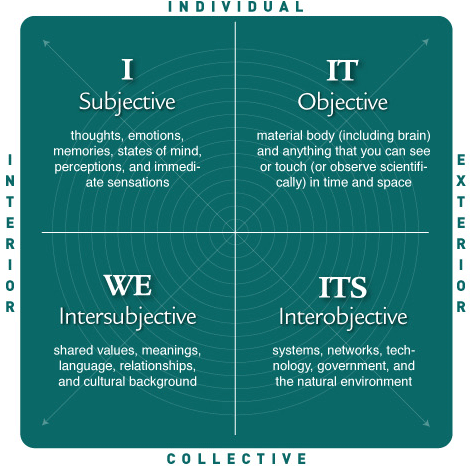
A brief overview of the Integral Four Quadrant model followed. This will be used later to frame our scanning hits.


And finally we started to plan the scanning work until next session. There are three framing decisions we each should reflect on:
1. Scale: What time frame are we looking at? We agreed that when we scan the environment of Hub we will keep three time frames in mind; 5 years, 10 years and 25 years ahead. Where are things going and how might things play out over those times?
 
2. Scope: How broadly are we scanning? Are we looking at Hub Melbourne, Hub Australia, Hub in Asia or Hub in a global perspective? This is another dimension each futures explorer should consider. We do not need to decide on this immediately, but it might emerge in a couple of weeks of scanning. 


3. Types of futures: What type of futures are we scanning?

From Maree Conway's Thinking Futures
Some scanning objectives:
  1. Arranged a Delphi in the community on Yammer with #hubfutures
  2. Made physically  visible the #hubfutures exploration for other Hubbers to contribute to on the physical Futures Wall
  3. Involved and sourced wisdom from the Hub Wisdom Council in person or via email
  4. Gained a broader perspective from the world (open foresight) via Twitter #hubfutures
  5. Engaged and involved global Hubbers through National Field.
Within a couple of weeks, please let the group know on Yammer what area you'd like to help scan.

And don't forget to tag everything with #hubfutures.


Wednesday, February 13, 2013

#hubfutures explorers induction

Copyright: Pete Holliday - @thesecondtier

This session started with a short introduction of what strategic foresight and futures studies are.

The overall Hub Foresight process will be based on a couple of theoretical frameworks from the futures and strategic foresight field, but also from organisational transformation and change. The following resources are good to have a look at, if you missed the session and are interested in some of the models we'll use:
An physical exercise to illustrate Scharmer's Theory U was followed by an individual exercise around creativity researcher Edward De Bono's Flowscape.

Some participants found that the Flowscape works in pairs as well...

 Both Theory U and Flowscape will be used later in the process....

Finally, we decided the dates for the remaining #hubfutures sessions. They are all posted as Yammer events, so please go here to sign up and add links to your private calendars.

PREPARATION FOR NEXT SESSION - INPUT 26 February.

1. Look at The Hub Ethos below compiled and presented by Julian Waters-Lynch last year, which is  important to understand as background for the Future of Hub process.


2. Bring three things that might influence the future of Hub. This might be anything that you think or feel is relevant - an article, a twitter post, a song, a quote, a thought, a dream, an intuition, a scene in a film etc.

And remember to tag all relevant things on twitter and yammer with #hubfutures !